
















 💖
💖

































































































































































 by
by 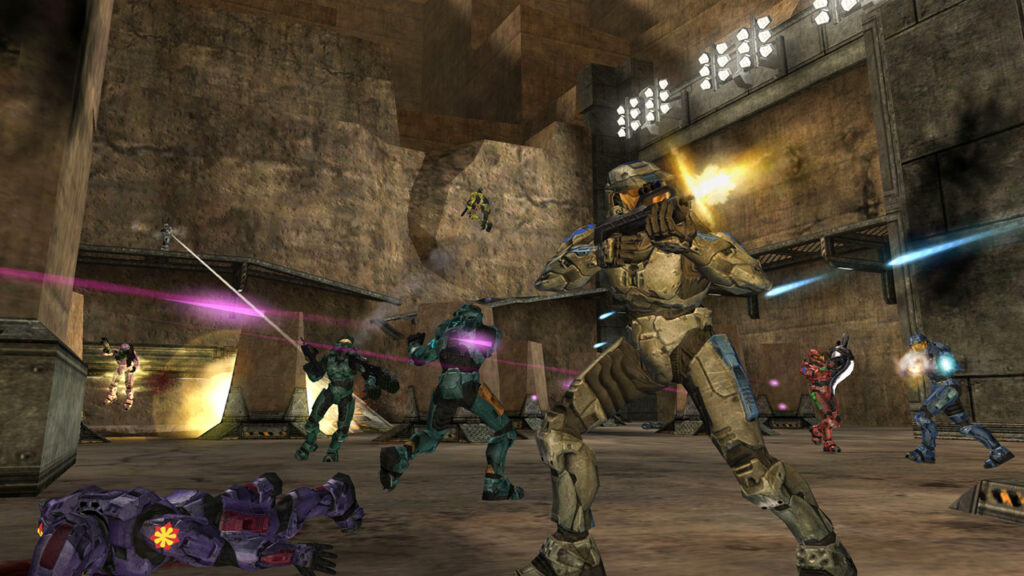
for over 10 years now, 343 industries has been forcing changes onto halo that nobody asked for and nobody needed. that's the root of the divide between players who want the series to stay true to bungie's vision and players who accept whatever 343 puts out.
one of the most common claims from 343 fans, especially in recent years, is that classic halo is too slow and boring. they rarely say it neutrally. it's almost always delivered with this weird disdain, worded in a way that mocks the original games and the people who enjoy them.
the original halo games were never too slow. they were designed with deliberate pacing that made methodical strategy the core of the experience.
halo was never trying to mimic the frantic speed of quake or the chaos of unreal tournament. it has its own rules, its own rhythm, its own identity. halo is halo.
a big reason critics of classic halo think the older games feel slow is because they're ignorant of how much FOV influences perceived speed. on their original xbox releases, both halo 2 and halo 3 ran at 30 fps with an FOV of around 70 degrees. that's low, and a low FOV always makes a game feel slower. 30 fps also feels slower than 60 fps.
the video shows side‑by‑side gameplay of halo 2 and halo 3 running at 1920x1080 and 60 fps, but with different FOV values. the higher FOV looks faster even though the base movement speed is identical.
back in the 2000s, devs usually set console FOV around 60-70 and pc FOV around 90-100. customizable FOV on consoles didn't really take off until after 2007. today most games run at 60 fps, ship with a default FOV of 90 or higher, and let players adjust anywhere from 70-120. gamers are used to high FOV and high framerate. so when they go back to a game with a low FOV, they interpret it as slow even when it isn't.
modern shooters also feel faster because they stack advanced mobility mechanics on top of high FOV and high framerate. that combination makes classic halo look slow to people who grew up on games released after 2007. but that perception is subjective, not accurate. the continued success and love for the original halo games proves the formula worked and still works.
it's also worth pointing out that sprint and other mobility mechanics don't automatically make a game fast‑paced. in some cases, sprint actually slows the game down. what determines the perceived speed of a game is the intensity of the experience, not whether you can run faster in a straight line.
a great example of how FOV affects perceived speed is this optical illusion by akiyoshi kitaoka, a professor of psychology at ritsumeikan university in japan. removing objects from your peripheral vision tricks your brain into thinking movement is slower than it really is.
the illusion below is another perfect example. cover the center and the outer dots look faster. cover the edges and the dots look slower. your brain fills in the gaps.

i originally posted this on twitter and was surprised by how much attention it got. thousands of people found it interesting, which was nice to see. it's a topic most players never think about, but it matters. FOV affects immersion, performance, and how we interpret the speed of a game. understanding that makes you understand halo better too.



























































FOV really does change everything. played halo 3 on MCC at 108 fov and it felt way faster. people just don’t realize how much perception matters!
Sprint isn’t even that bad. It allows for better engagement distances and creates opportunities for dynamic gameplay. Stop acting like Halo should never evolve.
It’s crazy how much FOV affects perception. Sprint doesn’t necessarily make games faster, but people assume it does because they feel the motion more.
Love seeing these detailed breakdowns of FOV and speed perception. Halo fans need more discussions like this instead of endless bickering.
Halo isn't supposed to be another twitch shooter. It's supposed to reward positioning and strategy. Sprint made people ignore positioning and just rush recklessly.
Halo was never slow. It was deliberate. If you think everything needs to be hyper-fast like COD, you’ve missed the entire point of Halo’s sandbox.
Finally, someone explaining why classic Halo isn’t "slow". The pacing was intentional, and it actually made the battles more strategic. Sprint ruined a lot of that for me.
Very impressive post. I never imagined you can affect the perception of speed based on the periferial vision. I am a fan of old Halo games, and I never felt the need for Halo games to go faster. I think it also has to do with the design of scenarios, particularly halo 3 multiplayer, where you can encounter opponents often, and strategic positioning is fundamental in many cases. Maps like "The Pit" and "Guardian" are good examples, but even large maps also were compelling. Traversing them was fun. Great job here. I will be checking out more of your posts. 👋
Hi Hailey! 🙂 Just discovered your content, mainly from your YouTube channel (Halo videos, more specifically). Just wanna say that i think u got an awesome perspective on Halo that i am quite in agreement with (i say this even though ive only rly jus seen the "halo 3 was getting 1 million players every night..." and "Bungie's Halo games were ass" videos lol but still).
Looking forward to seeing more content from you, whether here on your website or YouTube!